On this page
TypeSafe Jev is an AI model built to return structured decisions that software can act on. Released in early access on September 15, 2026, it targets work such as classification, routing, and scoring. Its launch attracted attention for dramatic speed and cost claims. Early tests give developers a reason to investigate, but three questions deserve separate answers: does the output fit the schema, is the decision correct, and can its uncertainty estimates be trusted?
What TypeSafe Jev actually does
Consider a customer email about a duplicate charge. A support workflow needs a few decisions: whether it is a complaint, how urgent it is, and which team should handle it. The output might be as simple as “complaint,” “high,” and “billing.”
Jev lets developers define those questions and their possible answers in advance. TypeSafe calls it the first of its System One Models, describing the interface as “unstructured state in, typed probabilistic decisions out.” Its launch announcement says it supports choices with up to 255 candidate values.
The official documentation lists three primitives: Choice for selecting an option, Score for evaluating against a rubric, and Noul for assessing whether a statement is true. Choice and Score expose both probabilities and a separate confidence field. Those terms should not be treated as interchangeable.
The practical appeal is that uncertainty becomes something the surrounding program can inspect. A workflow can use the results to route straightforward cases and flag ambiguous ones for review. Whether those rules work depends on how well the model performs on the actual inputs.
Defining the possible departments prevents an unexpected department name. It does not prevent a billing complaint from being sent to technical support.
What changes beyond structured outputs?
Existing LLM APIs already support structured outputs, including schemas that constrain the values a model can return. Developers do not have to accept a chatty paragraph and hope a parser can recover the answer.
Jev's proposed distinction is broader: TypeSafe says it has designed the model architecture, sampling, and training around structured decisions. Its launch describes outputs produced in parallel, avoiding the sequential text generation used by conventional autoregressive models.
| Dimension | LLMs with structured outputs | Jev's reported approach |
|---|---|---|
| Output scope | Text generation constrained to a supported schema | Predefined decision types and candidate values |
| Generation | Typically generates a serialized answer token by token | Produces decision outputs in parallel |
| Uncertainty | Depends on the model and interface; requesting a number does not establish calibration | Probabilities and, for Choice and Score, a separate confidence field |
| Reliability assessment | Test schema compliance and task accuracy | Test task accuracy and the usefulness of uncertainty estimates |
That makes “it returns JSON” an incomplete description of the product. It also makes “ordinary LLMs only return prose” an unfair comparison. The useful comparison is between systems configured to perform the same task, with equivalent output requirements.
Why RLCD matters
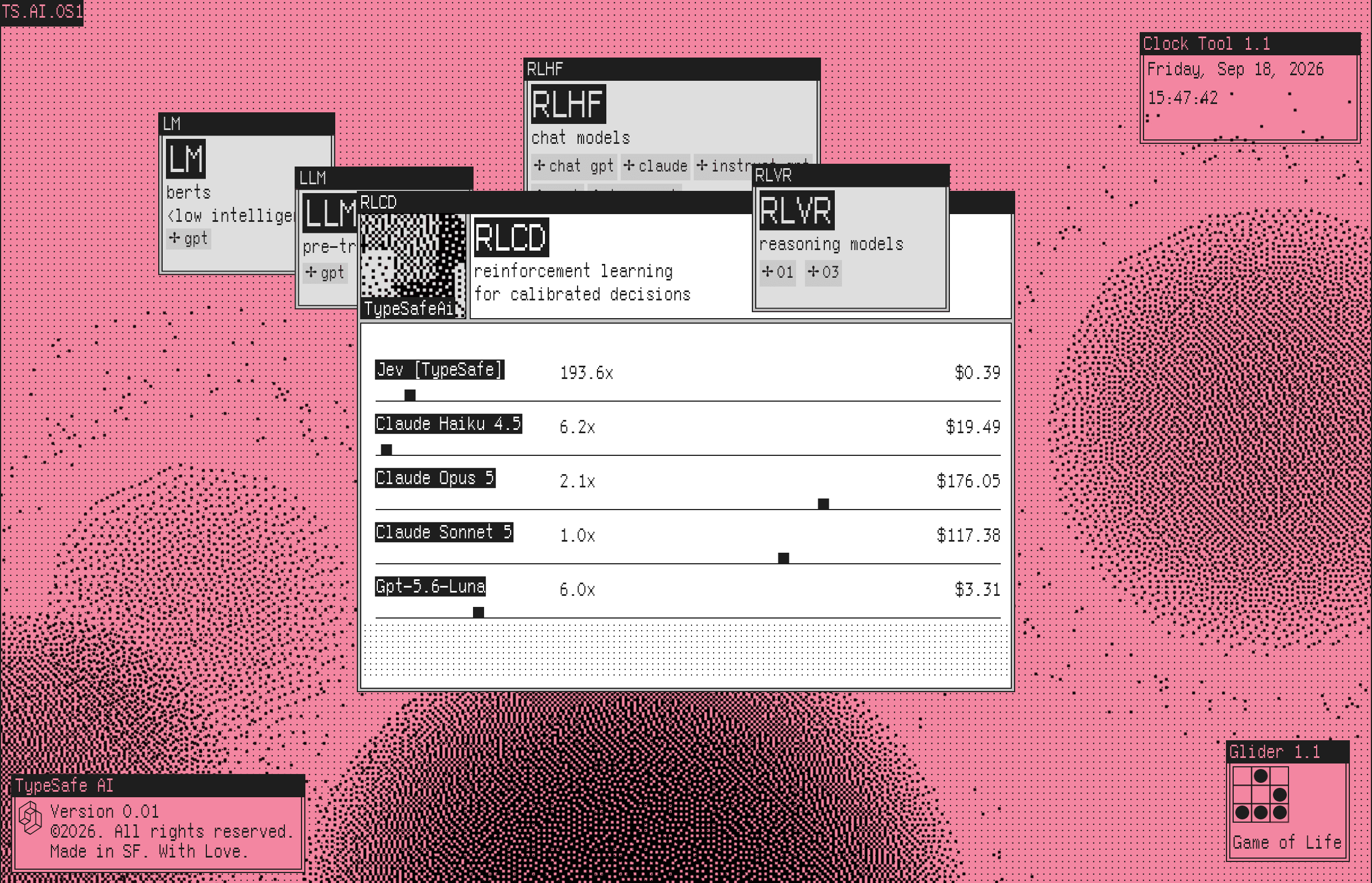
TypeSafe founder Diogo Almeida coauthored the InstructGPT paper, which helped establish the role of human feedback in teaching language models to follow instructions. With Jev, his team is pursuing Reinforcement Learning for Calibrated Decisions, or RLCD.
The objective is for reported probabilities to correspond to observed outcomes. If a model assigns a 90% probability of anger to a large group of messages, roughly 90% of those messages should express anger under the evaluation's labelling criteria.
That would make probabilities useful for setting decision rules. But the training objective and its success on a particular business task are separate matters. A developer still needs evidence that the estimates behave as expected on their data.
What the speed and pricing figures show
The strongest evidence for Jev so far concerns the economics of particular structured tasks. The size of the advantage depends on the workload and the comparison setup.
TypeSafe's workflow evaluations
At launch, TypeSafe listed Jev at $0.042 per million input tokens, equivalent to $42 per billion, with output tokens free. These are the published terms checked on September 18, 2026, rather than a guarantee of future pricing.
The company's headline claims of 193.6 times faster and 444.6 times cheaper come from four internal workflow evaluations. Its launch announcement includes several qualifications that belong alongside those numbers:
- The workflows were built by members of TypeSafe's model capabilities team.
- Reference answers were the average predictions of GPT-6 Astra and Fable 5.1, rather than independently labelled ground truth.
- Competing LLMs used a wrapper that returned structured decisions with probabilities. TypeSafe notes that this is slower and more expensive than obtaining decisions without probabilities.
- The company expects the headline gains to sit toward the high end of real-world results.
Agreement with reference models can be a useful evaluation signal. It is not the same as measuring correctness against verified outcomes. Likewise, the reported response times do not establish a latency guarantee for different input lengths, locations, or deployment conditions.
The pricing makes experimentation inexpensive. The benchmark gives developers a hypothesis to test, rather than a multiplier to put directly into a business case.
Every's hands-on tests
Every's Mike Taylor reported running 21 writing checks across 27 of his articles and 10 deliberately AI-styled counterparts. Jev returned 777 judgments in under 0.7 seconds, at an estimated cost of a quarter of a cent.
That is an interesting demonstration of throughput. Taylor also acknowledged that he would want a more thorough accuracy check before putting the results into production. Detecting writing patterns in this sample does not establish a reliable method for determining who or what wrote a document.
A second test, conducted by Every CEO Dan Shipper, compared Jev and Fable 5.1 at high effort on four checks across 12 synthetic passages. Six passages were clear versions; six contained deliberately introduced problems.
Jev's median response time was 0.35 seconds per passage, compared with 8.83 seconds for Fable. Its estimated cost was about 580 times lower. Jev caught six of the seven intended defects; Fable caught all seven.
Those results show a potentially useful trade-off in that experiment: much lower latency and cost, with one missed defect. Twelve synthetic passages cannot establish general accuracy, calibration, or production reliability. The numbers here are Every's reported measurements; this article does not independently reproduce them.
Does type safety mean Jev cannot hallucinate?
TypeSafe's “can't hallucinate” claim needs a precise definition. In its launch explanation, the company says its plotted zero rate is not empirical: schema matching is guaranteed by construction.
That addresses one kind of failure. A model constrained to “billing,” “technical support,” or “sales” cannot produce an unexpected fourth category. It can still choose the wrong permitted answer.
Three properties matter:
- Schema validity: the answer conforms to the allowed structure and values.
- Accuracy: the answer is correct for the task.
- Calibration: predicted probabilities correspond to observed frequencies across an appropriate set of examples.
A probability is useful only if developers understand what it measures and how it behaves. A model may be well calibrated across a broad dataset while performing poorly on a particular category or a new distribution of inputs. Even good calibration does not make an individual decision certain.
The paper “Why Language Models Hallucinate” helps explain why this distinction matters. It argues that common evaluation methods reward guessing when models are uncertain, and it distinguishes calibration metrics from hallucination metrics. It does not test Jev or validate RLCD.
Jev's interface creates a way to incorporate uncertainty into software. The launch materials and small outside tests reviewed here do not establish that its estimates are dependable across every domain. That remains something to measure before connecting a score to an automatic action.
Where Jev fits—and how to test it
Jev is worth investigating when the task repeats often and the answer can be expressed through a bounded set of decisions. Examples include routing support tickets, classifying documents, prioritizing submissions, or checking an AI-generated response against a defined rubric.
It is a narrower fit for tasks requiring arbitrary text extraction, and it gives up prose generation. A workflow that needs to classify a complaint and then write a reply may still need a text model for the second step. A guardrail built with Jev also remains a model judgment, not a verified safety guarantee.
Start with one decision your team already makes, then evaluate it in the system where it would be used:
- Build a labelled sample. Include ordinary cases, ambiguous inputs, rare categories, and examples where an error would be expensive. Reserve a held-out set for the final comparison.
- Use a fair baseline. Compare with your existing rules, classifier, or LLM configured for structured outputs. Match the required answers, and record differences in reasoning effort or probability reporting.
- Measure mistakes by consequence. Overall accuracy can hide failures in a small but important category. Track false positives and false negatives where they lead to different actions.
- Test uncertainty estimates. Check whether observed outcomes match the predicted probabilities. Measure the error rate among automatically handled cases alongside the share of cases that qualify for automation.
- Count the whole workflow. Include typical and slow responses, retries, fallback model calls, and human review. A cheap initial decision may still create expensive follow-up work.
Choose thresholds on validation data, then assess them on the held-out sample. There is no universally safe cutoff: the cost of sending a routine ticket to the wrong queue is different from the cost of missing an urgent complaint.
After deployment, monitor whether the input mix changes. New products, languages, or customer behaviours can alter performance even when the API response format stays identical.
Building the application around the decision with Atoms
A routing decision becomes useful when someone can submit a request, see its status, and correct a mistake. Those interactions belong to the application around the model. Atoms is an AI product-building platform that helps turn a natural-language brief into an editable website or web application.
For a support workflow, a useful brief could describe an intake form, a results view, and a review queue. Atoms' AI app builder provides a way to develop that product experience:
- Build from a product brief. Describe the audience, pages, and interactions to generate a working application for review.
- Iterate with specialized agents. Atoms coordinates AI agents across planning and building, with changes that can be previewed and refined.
- Add application infrastructure. Persistent data, authentication, and deployment workflows support products that need more than a static page.
Connecting a Jev endpoint and validating its decisions would remain separate implementation work. The reviewed Atoms product materials do not establish a native Jev integration.
For a customer-facing business, the application may start with a storefront. These examples illustrate that part of Atoms' capabilities; they are not demonstrations of Jev-powered automation.
Beverages Online Store is an e-commerce website for selling beverages.
Snacks Online Store is an online storefront for snack products.
Digital Watches Online Store presents TNNEY / Sport Time, a premium sports-watch brand, through a product landing page and storefront.
Conclusion
Jev makes a credible case for testing cheaper, faster decisions inside software. Its early results are strongest as evidence for specific workloads; reliable automation still requires measuring errors and validating uncertainty estimates. Pick one recurring judgment, compare it fairly, and decide which mistakes your workflow can tolerate. When you are ready to build the application around that workflow, Atoms can help turn its screens and interactions into a product you can review.
Turn your workflow idea into a web application. Build with Atoms.
A little more clarity
Frequently asked questions
01Q1: Is TypeSafe Jev available to everyone?
Jev launched in early access on September 15, 2026. As of the materials checked on September 18, TypeSafe was admitting developers through its waitlist; that should not be described as general availability.
02Q2: Does free output mean Jev requests are free?
No. TypeSafe's published launch price is $0.042 per million input tokens, with output tokens free. Request costs still depend on the input, and published pricing may change.
03Q3: Are probabilities and confidence the same thing?
The documentation lists them as separate fields for Choice and Score. Developers should use each according to its documented semantics and validate how it behaves on their task; neither should be interpreted as a guarantee of correctness.
04Q4: Should Jev replace an entire LLM workflow?
Start by testing it on one bounded decision. A larger workflow may still need a text model for replies, summaries, or other generated content, along with rules and human review for cases that require them.
05Q5: Can Atoms build a product that uses model decisions?
Atoms supports building web applications from natural-language requirements, including relevant interfaces and backend capabilities. Any external model integration still needs implementation and testing, and generated applications need engineering review before production use.
Source scope: Product and pricing claims were checked against TypeSafe's launch announcement and documentation on September 18, 2026. Performance examples are attributed to TypeSafe or Every; no original benchmark was conducted for this article.
Share this article
 Posts
