On this page
AI has not reached AGI. But the AI supply curve is already changing.
The important shift is not only that models answer more accurately. It is that the cost of adapting intelligence to a new task is falling—and the value of that adaptation depends on whether it can enter a real production workflow.
A robot that learns a short manipulation task from one demonstration, a small language model trained for negotiation, and an anonymous model distributed through an API may look like unrelated stories. They are signals of the same transition:
AI competition is moving from raw capability toward adaptation cost, training objectives, and distribution.
The companies that benefit most will not necessarily own the model with the highest general benchmark score. They will be the ones that connect cheaper adaptation to data, tools, verification, and business execution.
The AI supply curve is becoming more elastic
The traditional model race asks:
- Which model is smartest?
- Which model scores highest?
- Which model has the largest context window?
Those questions still matter. But production systems also need to ask:
- How quickly can the model learn a new task?
- How many demonstrations or labels does adaptation require?
- Can a smaller model handle a well-defined workflow?
- What behavior does the training objective encourage?
- How does the capability reach developers and users?
- What does it cost to verify and operate the result?
This is an AI supply-curve question. If a capability can be adapted with fewer examples, less training compute, less human intervention, or a smaller model, more organizations can afford to use it.
That does not mean intelligence becomes free. It means the boundary between an expensive frontier capability and an ordinary production workflow can move.
Signal one: adaptation cost is falling
Generalist presents GEN-1.5 as an embodied foundation model that can learn new tasks from very short demonstrations. This is official company positioning; it is not independent evidence of industrial reliability. — Source: Generalist
Generalist’s GEN-1.5 is a clear example of the adaptation-cost trend in physical AI. Generalist says the model can in-context learn a new task from 3 to 12 seconds of demonstration data, without updating its weights. The company also reports that the model can adapt with 1 to 10 gradient steps using minutes of data.
In the company’s reported tests across ten short manipulation tasks:
- one-shot prompting produced an average success rate of 59%;
- adaptation using about five minutes of data and ten gradient updates produced an average success rate of 83%.
These numbers need a narrow reading. They are company-reported results from short, selected tasks. They do not establish industrial reliability, broad robotics generalization, or robot AGI. They do show why adaptation cost is becoming an independent competitive variable.
Historically, a new physical behavior could require task-specific programming, data collection, and engineering. If a model can acquire a usable starting policy from a few seconds of demonstration, the bottleneck shifts. The hard questions become:
- Can the behavior be verified?
- Does it transfer to new objects and environments?
- How does the system recover from failure?
- What happens when the task is safety-critical?
- Can the adaptation process scale beyond a carefully controlled demo?
The lesson is not “one-shot learning solved robotics.” The lesson is that less task-specific adaptation can change the economics of deploying specialized behavior.
Signal two: the training objective is a product decision
A second signal comes from SocialRL, a research direction that trains social reasoning directly into a small language model rather than relying only on general pretraining.
The work applies reinforcement learning to a 4B model across interaction domains including Deal-or-No-Deal, CaSiNo, Craigslist, Job Interview, Calendar, and Marketplace. The goal is not to make the model universally smarter. It is to make it better at reasoning about other agents, private information, negotiation, and strategic interaction.
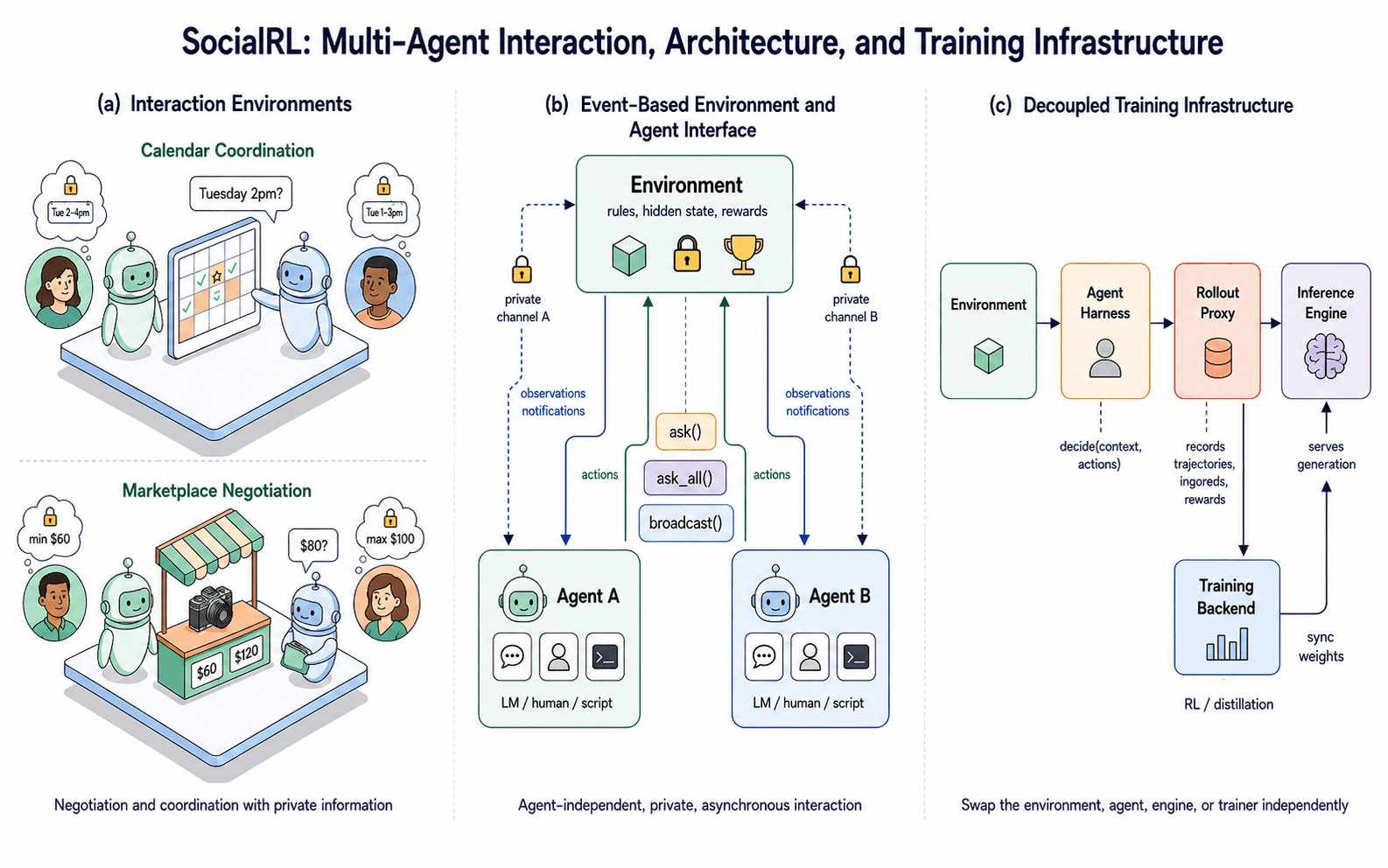
SocialRL’s figure presents interaction environments, an event-based agent interface, and decoupled training infrastructure. It is a conceptual architecture figure, not standalone proof of performance or production scalability. — Source: SocialRL paper
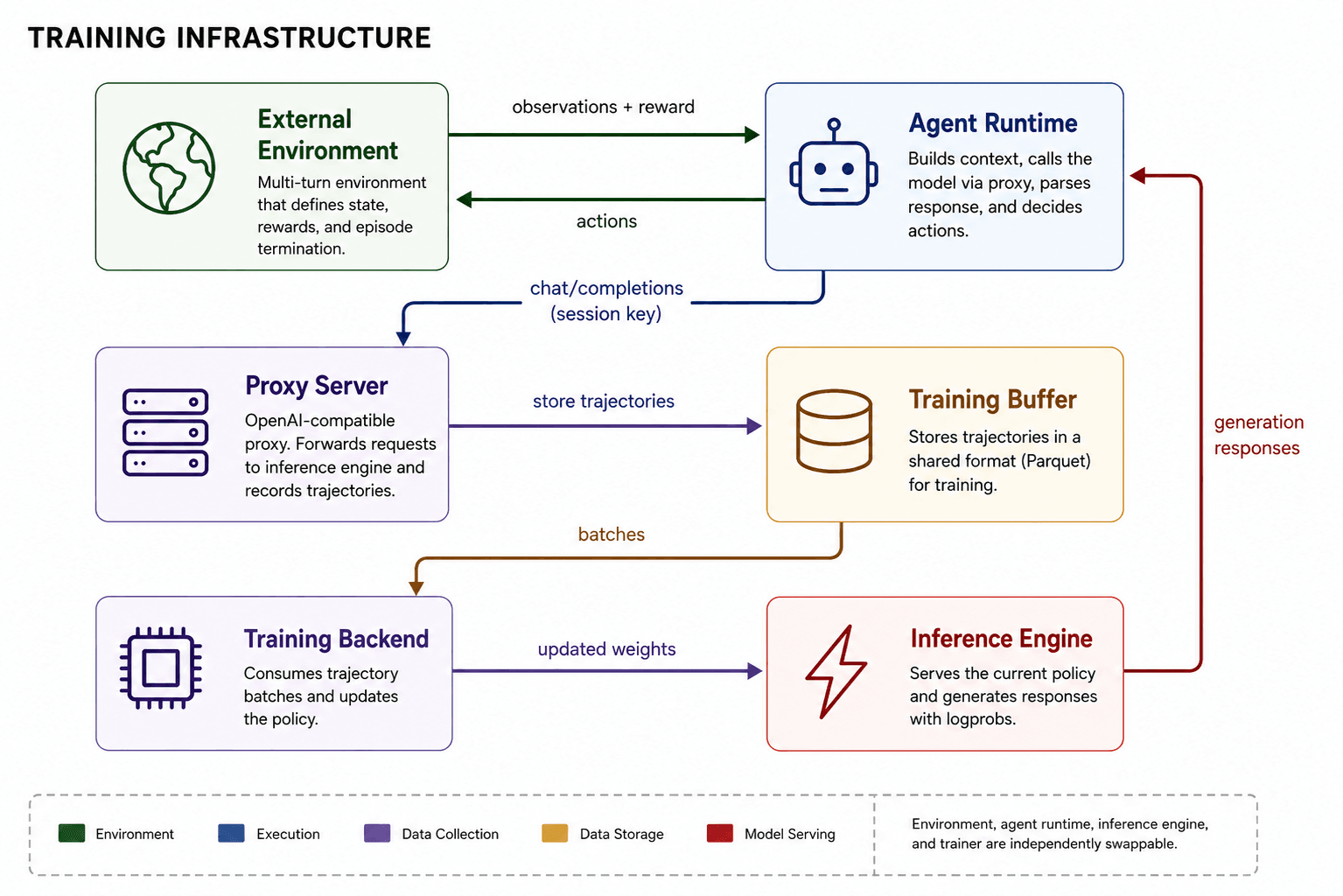
The SocialRL training diagram connects environment interaction, agent runtime, trajectory storage, training, and inference. It describes the proposed pipeline; it does not independently establish deployment scale or economic productivity. — Source: SocialRL paper
This distinction matters for AI economics. A smaller model trained against a precise environment and feedback signal may be more useful for a bounded business task than a larger general model used without task-specific structure.
But the claim must stay narrow:
A 4B model can enter the performance range of larger frontier systems on selected negotiation environments after targeted training.
That is not the same as saying the 4B model generally beats GPT-5.x. Benchmark tasks, reward functions, evaluation protocols, and deployment costs all shape the result.
The deeper point is that the training objective becomes part of the product. A model trained to maximize agreement may behave differently from one trained to protect a user’s reservation price. A model trained to be agreeable may become a poor negotiator. A model optimized to pursue a principal’s interests may become more effective—and more capable of strategic pressure.
When evaluating a specialized model, ask not only how many parameters it has. Ask:
- What behavior is being rewarded?
- Which environment generated the feedback?
- What information is hidden from the model?
- What counts as success?
- What failure modes does the reward leave untouched?
Why small models can matter more than large models
The value of a model is not determined by parameter count alone.
A smaller model may win a production workflow when it offers:
- lower inference cost;
- lower latency;
- easier local deployment;
- more predictable tool use;
- narrower but more reliable behavior;
- simpler privacy and compliance boundaries;
- cheaper fine-tuning or adaptation;
- enough quality for a clearly defined task.
A frontier model may still be the right choice when the task is ambiguous, high stakes, multimodal, or difficult to verify. The practical architecture will often be heterogeneous: a small model handles routine classification, a specialized model handles coding or negotiation, and a stronger model is called only when the workflow stalls or the cost of error rises.
This is the same logic behind modern AI agent routing. Model selection should follow task requirements, workflow state, cost, latency, and reliability—not a permanent “best model” ranking.
Read the related analysis: AI Agent Routing: Why Long-Running Agents Need a Team of Models.
Signal three: distribution is part of intelligence
The third signal is distribution.
Ox Alpha appeared on OpenRouter as a stealth model operated by an anonymous third-party provider. OpenRouter’s listing makes an important separation: OpenRouter can provide access and routing without being the model’s developer or owner.
OpenRouter’s public Ox Alpha listing is the source for the model’s visible availability and metadata. A favicon is used here only as a source marker, not as evidence of model performance. — Source: OpenRouter
The listing itself demonstrates a new distribution pattern. Developers can call, test, and discuss a model before the model creator becomes publicly identifiable. The API, model catalog, default routing, pricing, and developer communities become part of the model’s market entry.
This is why model competition has at least four layers:
- Capability — how difficult a problem the model can solve.
- Adaptation cost — how cheaply it can learn a new task.
- Distribution — how easily developers can discover and call it.
- Execution infrastructure — whether the capability can connect to data, tools, permissions, and business workflows.
A model that is slightly weaker but available through a convenient API can spread faster than a stronger model that is difficult to access. Conversely, a widely distributed model may create little value if it cannot be verified, governed, or connected to real actions.
The economics of bottleneck removal
AI does not need to replace an entire profession to create economic value.
It may be enough to remove one expensive bottleneck:
- searching a large space of candidates;
- triaging routine cases;
- drafting a first version;
- checking a known set of constraints;
- routing requests to the right specialist;
- generating and testing software changes;
- monitoring a workflow for exceptions.
A useful mental model is:
The subtraction is critical. If an AI system generates output cheaply but requires so much checking, correction, and integration that the savings disappear, the system has not created production productivity.
This is also why “AI productivity” claims should be connected to an end-to-end workflow. Measure accepted results, not only generated tokens or benchmark points.
From model capability to organizational capability
AGI may arrive—or may not arrive—as one universally agreed model milestone. Before that happens, organizations can still develop very different levels of effective intelligence.
One company may have:
- proprietary data;
- clean software interfaces;
- reliable evaluation;
- permissioned tool access;
- human review paths;
- strong operational feedback;
- a workflow that turns model output into action.
Another company may call the same model through a chat window and receive much less value.
The difference is not only model quality. It is organizational capability: the ability to connect intelligence to data, tools, verification, and responsibility.
This is where AI-native software platforms become important. Atoms uses a multi-agent workflow in which specialized AI employees can contribute to different parts of the product lifecycle:
Instead of treating “build a product” as one prompt for one general model, Atoms coordinates different roles and work products. The approach is designed for the practical bottlenecks that determine whether an AI idea becomes a working product.
See AI agents for building apps and websites on Atoms, AI coding agents, and AI Website Builder.
Why AI website builders are a useful test case
An AI website builder exposes the entire supply curve in one workflow.
A simple landing page may need only text and layout generation. A real product can require:
- market and audience research;
- information architecture;
- frontend implementation;
- database schema;
- authentication;
- authorization;
- payment flows;
- server-side logic;
- responsive testing;
- SEO content;
- deployment;
- monitoring and iteration.
No single model is equally good at all of these steps. A multi-agent system can assign research to a research agent, architecture to an architecture agent, implementation to a coding agent, visual review to a vision-capable agent, and SEO to a specialist agent.
Atoms is built for this kind of workflow. Its AI website builder and AI app builder connect natural-language requirements to a multi-agent development process. Atoms Backend provides the backend surface for persistent data, authentication, and application logic. Atoms Cloud provides managed hosting and deployment paths. Stripe integration supports payment workflows where the product requires them.
The important distinction is not that Atoms magically removes every engineering risk. It is that the platform treats product development as coordinated work across specialized roles rather than a single-shot UI generation problem.
Read Production-Ready AI App Builder: From Prototype to Real Product for the infrastructure checklist behind this claim.
The next competitive advantage: adaptation plus execution
The three signals fit together:
GEN-1.5 shows how fewer demonstrations could reduce the cost of adapting physical behavior. SocialRL shows how a targeted training objective can push a small model toward stronger performance on bounded social tasks. Ox Alpha shows how an API distribution layer can make a model available before its identity is widely understood.
None of these examples proves AGI. None proves that a benchmark result automatically creates business value. Together, they point to a more useful way to evaluate the AI market.
The key question is not simply:
Which model is smartest?
It is:
Which system can adapt to the next valuable task at acceptable cost, pursue the right objective, reach the user through a reliable distribution channel, and operate inside a verifiable workflow?
Final takeaway
AGI has not arrived as a settled milestone. But the economics around intelligence are already changing.
The supply of usable AI capability expands when adaptation takes fewer examples, when specialized training fits smaller models, and when distribution connects those models to developers. The value becomes real only when the capability survives verification, integrates with tools and data, and produces an accepted business result.
That is the competitive frontier now: not intelligence in isolation, but intelligence that can be adapted, distributed, routed, and executed.
